I chose to watch two videos from the “Learning Science Through Inquiry” website. I watched “Workshop 1:What is Inquiry and Why Do It?” and half of “Workshop7: Assessing Inquiry.” I chose these two videos because I still didn’t really understand what inquiry exactly was, and I was curious as to how to assess students when using inquiry. After watching the first video, I have a little better understanding of what inquiry is. For me, it reinforced what we have been learning in class about the whole inquiry process. In this video, they emphasized that inquiry is a student-generated investigation that starts with student curiosity. This curiosity is activated by some event in nature however, and the role of the teacher is to get students wondering about something. This fits in with the I-AIM model’s first stage, which is engage. As a teacher, you pique students’ curiosity by engaging them in new experiences or drawing on their prior experiences in order for them to pose a question. This also fits in with the EPE Framework (Experiences, Patterns, Explanations) since it uses experiences to generate curiosity. This was seen in the classroom example during a 1st grade inquiry project on sharks. After completing a unit on spiders, students concluded that spiders were misunderstood animals. The teacher noticed that students in her class talked about sharks in the same way as spiders, for example, “They are scary and mean animals.” Students built upon their prior knowledge of spiders being misunderstood animals and wondered if sharks were too. The students kept science folders of their daily questions, discoveries and compositions about the topic, as they began exploring the shark phenomena. Explore is the second stage of the I-AIM Model. The students shared these folders during a “Folder Walk” with their peers and the teacher. This informed the teacher about what the students were wondering and thinking about. For example, one 1st grade girl wondered why shark fins stick out of the water. During this part of the inquiry process, students are also looking for patterns (EPE) in their experiences to formulate hypotheses. For example, some students began to think that sharks are fish. During this exploration, students looked at real-life artifacts provided by the teacher, to further their thinking and generate more questions and ideas. The artifacts helped to keep the investigation authentic and real to students. They talked about their ideas in small groups as they messed around with the materials. This allowed students to develop explanations (EPE and I-AIM) and share them with others based on the evidence in front of them. I saw this in the example classroom when students looked at baby sharks that were preserved in a bottle in groups, to see if what was in front of them was indeed a shark and why. Even though one of the students pointed out the fact that it said “shark” on the bottle, the teacher asked, “Do you always believe what is written?” The student said, “no,” so the teacher said, “well how do we know this to be true then?” This showed me that in inquiry, students try to not only formulate their own explanations based on experiences, but also how they connect evidence (experiences) to explanations. It is very important to learn to ask, “how do we know this is true?” since a lot of what we learn about things is told to us from books, news broadcasts, etc.
I saw a lot of the apply stage of the I-AIM model when watching the video on assessment. This video stressed that it is important to get as many ‘different lenses to look through’ to effectively evaluate a student, since students prefer to express their ideas in various ways (talking, drawing, writing, etc). There are many different ways to go about doing this such as embedded and ongoing assessment, as well as formal assessments where students help to assess one another. I really liked how the 1st grade teacher looked at her students’ journals on a daily basis and their portfolios to track their inquiry process. This shows the teacher if the students understood what they did today as well as inform you on your own teaching performance. The teacher also kept her own journal of what she noticed students were learning and took notes on them. This helped to get to know her students. She decided to share it with her students so that they could receive feedback of their learning since feedback helps you learn. A more formal way of assessing students was to have students create projects of their choice that reflect what they learned through the inquiry process. This required students to apply what they learned to explore and explain real-world examples and to ask more questions about the topic. For example, a third grade group of boys created a bait box project after completing an inquiry on worms. This was a more effective way than unit tests to find out what students know. It is also more engaging for them to develop practical applications of what they learned. It is also more meaningful for students if they help to think of the ways that they will be assessed. For example, when the class created a rubric together. 1st graders even did it with some time and modeling, as shown in the video. One very important thing to keep in mind with assessment is to many sure it is tied to the learning goal. I learned that you should assess in an ongoing way so that you can make sure students are meeting the learning goal throughout the process, because if you wait until the end, it will be too late since you will be moving on to the next thing.
During this whole inquiry process, the students’ role is to be a problem-solver while the teacher is a facilitator. I noticed that throughout both of these videos, the teacher was there to facilitate and guide them by helping them out if they got stuck in their learning. They often did this by asking the student “why?” or give them some new idea to think about. I think it is important to note that the students were the ones making up their own questions, constructing their own knowledge. The teacher encouraged the students to evaluate their ‘thinkings’ critically. They did not just tell them if they were right or wrong, nor give out facts. Instead, teachers just gave students a lot of time to think. I will keep this in mind when I teach.
By watching these videos, it has shown me that inquiry can start at a very young age. I had previously held the misconception that young children can’t do inquiry and that inquiry-based teaching would be too difficult to do with young students, but when in fact most of the examples given in these videos were from a 1st grade class. This has shown me that inquiry can start early, and no matter what grade I end up teaching or how diverse my students are, I can do inquiry with my students. Also, the first grade teacher talked about how she participated in inquiry on her own outside of the classroom. I think this is a good thing that I should try to do as a teacher since if I do it outside of the classroom too, I will be more likely to help foster and use it in my classroom with my students.
One thing is for sure; I will definitely not just teach out of the textbook or lecture to students. After watching these videos, I now know how much more beneficial it is for student learning to have inquiry-based science teaching. Students had real ownership of their learning and assessment during inquiry.
Tuesday, April 29, 2008

Sunday, April 20, 2008
Walk It Out
Field #12
April 15, 2008
This week in field, I did not see any science lesson taught because the students went outside to walk laps around the school instead. My CT is doing some sort of program where she logs how far the class walks each day. I am not sure what it is for exactly, but I will ask next time I go to field. Everyday, if it is nice out, my CT takes her students outside to walk laps around the school. The kids enjoy being outside rather than being stuck inside all day. This little bit of recess seems to help some of the behavior problems in the class because students are able to run outside, so when they come back inside they are tired out. Like I said, I am not sure exactly why my CT has the students walking everyday, but it could fit into science if she turned it into some sort of health lesson (about the need for exercising and eating well), or she could also integrate science into their walks by pointing out things in nature as they encounter things. Right now, they are just walking to walk, with my CT leading the line of single-filed students trying desperately to keep up with her fast pace.
April 15, 2008
This week in field, I did not see any science lesson taught because the students went outside to walk laps around the school instead. My CT is doing some sort of program where she logs how far the class walks each day. I am not sure what it is for exactly, but I will ask next time I go to field. Everyday, if it is nice out, my CT takes her students outside to walk laps around the school. The kids enjoy being outside rather than being stuck inside all day. This little bit of recess seems to help some of the behavior problems in the class because students are able to run outside, so when they come back inside they are tired out. Like I said, I am not sure exactly why my CT has the students walking everyday, but it could fit into science if she turned it into some sort of health lesson (about the need for exercising and eating well), or she could also integrate science into their walks by pointing out things in nature as they encounter things. Right now, they are just walking to walk, with my CT leading the line of single-filed students trying desperately to keep up with her fast pace.
Sunday, April 13, 2008
Class Assignment: Teaching Scenarios
One of the scenarios that I initially said I would not teach was scenario #1: “You, as a teacher, are teaching a unit on space. Each day during the unit you read to the class from a chapter book about the solar system. After reading about a particular planet, you ask students to make a statement on the board for inclusions in a letter sent home to parents at the end of the day.”
I feel that this is just rote learning, having children recall facts from a book. It does not get students actively thinking about the ideas to create meaningful learning. By just recalling facts, it does not tell you whether students are actually learning anything or making meaning. They will most likely forget those facts in a few days anyway. One way to make this activity more inquiry based is to have students ask their own questions of the solar system based on the background information given in the book. Part of inquiry is to not just accept what is told to you as facts, but to ask “how do we know this to be true?” The readings in the book could serve as the spark for children to inquire about the solar system. Through doing this, students may also ask their own further questions and seek to find those answers.
Another scenario that I initially said I would not teach was scenario #20, which stated, “You, as a teacher, decide that the best way to introduce your unit on ecosystems is to define the terms that students need to know such as carnivore, herbivore, and omnivore.”
I do not like this one because I think giving definitions is a terrible way to introduce a unit. It does not engage the students whatsoever or get them excited about what they are about to learn. The first stage in inquiry is to engage, and this definitely does not engage students. Instead, I would find interesting ways to engage students in a study on ecosystems depending on the grade level, perhaps through an exploration field trip to a marsh ecosystem, like we did in SME. I will then allow students to come up with their own questions that they have about the ecosystems, to tailor my unit around student interests. After the field trip, I could then give students a bunch of pictures of animals that were found in the ecosystem and let the students figure out how they might relate to one another. The students will hopefully find patterns and draw their own conclusions about the eating habits of certain animals and their relationship to one another. Giving students formal definitions can be one of the last things to do. This activity is more inquiry-based than the didactic approach proposed in scenario #20 because it engages students, allows them to explore an ecosystem. These are the first two steps in inquiry-based teaching.
I feel that this is just rote learning, having children recall facts from a book. It does not get students actively thinking about the ideas to create meaningful learning. By just recalling facts, it does not tell you whether students are actually learning anything or making meaning. They will most likely forget those facts in a few days anyway. One way to make this activity more inquiry based is to have students ask their own questions of the solar system based on the background information given in the book. Part of inquiry is to not just accept what is told to you as facts, but to ask “how do we know this to be true?” The readings in the book could serve as the spark for children to inquire about the solar system. Through doing this, students may also ask their own further questions and seek to find those answers.
Another scenario that I initially said I would not teach was scenario #20, which stated, “You, as a teacher, decide that the best way to introduce your unit on ecosystems is to define the terms that students need to know such as carnivore, herbivore, and omnivore.”
I do not like this one because I think giving definitions is a terrible way to introduce a unit. It does not engage the students whatsoever or get them excited about what they are about to learn. The first stage in inquiry is to engage, and this definitely does not engage students. Instead, I would find interesting ways to engage students in a study on ecosystems depending on the grade level, perhaps through an exploration field trip to a marsh ecosystem, like we did in SME. I will then allow students to come up with their own questions that they have about the ecosystems, to tailor my unit around student interests. After the field trip, I could then give students a bunch of pictures of animals that were found in the ecosystem and let the students figure out how they might relate to one another. The students will hopefully find patterns and draw their own conclusions about the eating habits of certain animals and their relationship to one another. Giving students formal definitions can be one of the last things to do. This activity is more inquiry-based than the didactic approach proposed in scenario #20 because it engages students, allows them to explore an ecosystem. These are the first two steps in inquiry-based teaching.
Monday, April 7, 2008
Another Spring Break!
Field #11
April 8, 2008
I did not go to the elementary school this week due to the fact that they have spring break this week!
April 8, 2008
I did not go to the elementary school this week due to the fact that they have spring break this week!
Friday, April 4, 2008
Tundra vs. Desert vs. Michigan
Field 10
April 3, 2008
Today I taught my social studies lesson instead of doing science. My lesson did tie into science because although it was a geography lesson, we talked about the different animals and weather than could be found in the desert, tundra, and Michigan as well as where the regions were found in the United States and what kinds of activities people did there. Overall, it was a compare and contrast of these regions. I thought that this lesson went very well, and my CT thought so too! She gave us very positive feedback after the lesson and really liked how we fed off one another with our lessons, and how we tied them together. My partner taught the first part of the lesson, on the desert, and then I continued the lesson immediately after to teach about the tundra (or basically Alaska since that is the only place in the United States with this type of region.) After reading them a book on each of these places, we had a discussion of what types of things they remember about the tundra from the book. I recorded these on a white board. The students loved to focus on the types of animals found there, so I had to also steer them in the direction of “what kinds of activities do people do there?” or “well you mentioned that it was very cold there, then what kinds of clothes do you think you would have to wear in the tundra?” (Just to keep the social studies focus a little.) I think that the students did learn a lot from my lesson in both a science and social studies way. Thinking back, this lesson could have really been an integrative lesson, where science, social studies, and language arts were integrated into one lesson, since we I read them a book and we had a discussion (language arts), talked about where the tundra is located in the United States and how people live there (social studies), and also the climate and animals found in the regions (science). Overall, I enjoyed teaching both my science lesson last week and my social studies lesson this week. I can’t wait to teach more of them next year to get even more practice. For right now, I am very relieved to have both of them finished, and right now, I am counting down the days until the end of the semester! Only 2 more weeks in the field!!
April 3, 2008
Today I taught my social studies lesson instead of doing science. My lesson did tie into science because although it was a geography lesson, we talked about the different animals and weather than could be found in the desert, tundra, and Michigan as well as where the regions were found in the United States and what kinds of activities people did there. Overall, it was a compare and contrast of these regions. I thought that this lesson went very well, and my CT thought so too! She gave us very positive feedback after the lesson and really liked how we fed off one another with our lessons, and how we tied them together. My partner taught the first part of the lesson, on the desert, and then I continued the lesson immediately after to teach about the tundra (or basically Alaska since that is the only place in the United States with this type of region.) After reading them a book on each of these places, we had a discussion of what types of things they remember about the tundra from the book. I recorded these on a white board. The students loved to focus on the types of animals found there, so I had to also steer them in the direction of “what kinds of activities do people do there?” or “well you mentioned that it was very cold there, then what kinds of clothes do you think you would have to wear in the tundra?” (Just to keep the social studies focus a little.) I think that the students did learn a lot from my lesson in both a science and social studies way. Thinking back, this lesson could have really been an integrative lesson, where science, social studies, and language arts were integrated into one lesson, since we I read them a book and we had a discussion (language arts), talked about where the tundra is located in the United States and how people live there (social studies), and also the climate and animals found in the regions (science). Overall, I enjoyed teaching both my science lesson last week and my social studies lesson this week. I can’t wait to teach more of them next year to get even more practice. For right now, I am very relieved to have both of them finished, and right now, I am counting down the days until the end of the semester! Only 2 more weeks in the field!!
My Science Lesson!
Field #9
March 25, 2008
 Today I taught my science lesson to the whole kindergarten class! It followed Carly’s lesson on “what a plant needs.” My lesson was about how plants change as they grow. I feel like my lesson went pretty well, but it definitely could have been better as far as classroom management. This is probably one of my greatest weaknesses so far as a student teacher. Hopefully I will be able to improve on this next year when I have more control of the class on a regular basis, rather than one day per week.
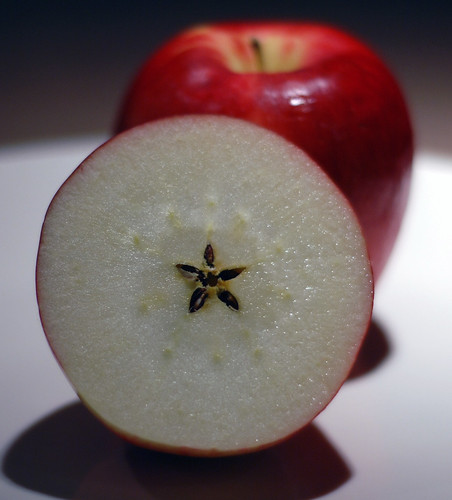
I modified my lesson a little bit after not being able to find the original book that I wanted to use for this lesson entitled The Big Seed. While looking for a different book to use, I thought back to my Science Talk and how some of my students held the misconception that if you give seeds apple juice, they will turn into apple trees. While at the public library, I found a book entitled How Do Apples Grow? By Betsey Maestro. I thought that this was a very appropriate book for my students and for my lesson, so I used this book instead. It went through the life cycle of an apple tree, while also talking about the different parts of the plant and what they do as the plant changes. At one point in the book, it shows us that if you cut the apple in half, you can see the seeds inside in the shape of a star. I paused at that page and brought out an apple I brought to show the students this is real-life. They were really interested in this as they passed the apple around. I think now their misconception is hopefully fixed!
March 25, 2008
 Today I taught my science lesson to the whole kindergarten class! It followed Carly’s lesson on “what a plant needs.” My lesson was about how plants change as they grow. I feel like my lesson went pretty well, but it definitely could have been better as far as classroom management. This is probably one of my greatest weaknesses so far as a student teacher. Hopefully I will be able to improve on this next year when I have more control of the class on a regular basis, rather than one day per week.
 I modified my lesson a little bit after not being able to find the original book that I wanted to use for this lesson entitled The Big Seed. While looking for a different book to use, I thought back to my Science Talk and how some of my students held the misconception that if you give seeds apple juice, they will turn into apple trees. While at the public library, I found a book entitled How Do Apples Grow? By Betsey Maestro. I thought that this was a very appropriate book for my students and for my lesson, so I used this book instead. It went through the life cycle of an apple tree, while also talking about the different parts of the plant and what they do as the plant changes. At one point in the book, it shows us that if you cut the apple in half, you can see the seeds inside in the shape of a star. I paused at that page and brought out an apple I brought to show the students this is real-life. They were really interested in this as they passed the apple around. I think now their misconception is hopefully fixed!
Reflections on Small Group Presentations
Reflections on Small Group Presentations
(From in-class activity on March 24)
I liked how we were to apply what we know about teaching science to create a lesson plan to teach our class on the articles. I liked the presentations that didn’t just make a PowerPoint of the facts and theories presented in the article, but rather those that taught us through something else, such as an activity. I was definitely more engaged in the activity ones more than the lecture presentations. I already read the articles, so I thought it was boring and just pointless to be lectured about them again by a group, especially the Inquiry at the Window article since I read it at home, created a lesson to teach the class about it in class, and then had to listen to it AGAIN from another group. It was interesting to see though how two different groups could teach the same thing in different ways. I think I would have liked it better if we just had two groups, so that we wouldn’t have had to listen to the same thing twice, but by doing it this way, it shows us that there are many different ways to go about teaching something, some more engaging than others. I think that you chose to do this activity today to show us just this. We have been talking all semester about how to get students engaged through inquiry, and this activity was to see if we could apply what we knew about it, to teach our fellow classmates. I think some groups definitely did a better job of this than others. The reason you had us to this during class time was because as teachers, sometimes we do not have a lot of time to plan a lesson for various reasons. This activity was an example of how to prepare and use what you have to create the best lesson possible in the limited amount of time that we had.
(From in-class activity on March 24)
I liked how we were to apply what we know about teaching science to create a lesson plan to teach our class on the articles. I liked the presentations that didn’t just make a PowerPoint of the facts and theories presented in the article, but rather those that taught us through something else, such as an activity. I was definitely more engaged in the activity ones more than the lecture presentations. I already read the articles, so I thought it was boring and just pointless to be lectured about them again by a group, especially the Inquiry at the Window article since I read it at home, created a lesson to teach the class about it in class, and then had to listen to it AGAIN from another group. It was interesting to see though how two different groups could teach the same thing in different ways. I think I would have liked it better if we just had two groups, so that we wouldn’t have had to listen to the same thing twice, but by doing it this way, it shows us that there are many different ways to go about teaching something, some more engaging than others. I think that you chose to do this activity today to show us just this. We have been talking all semester about how to get students engaged through inquiry, and this activity was to see if we could apply what we knew about it, to teach our fellow classmates. I think some groups definitely did a better job of this than others. The reason you had us to this during class time was because as teachers, sometimes we do not have a lot of time to plan a lesson for various reasons. This activity was an example of how to prepare and use what you have to create the best lesson possible in the limited amount of time that we had.
Subscribe to:
Comments (Atom)
